Importance of Marketing to business
- It sells products and services to consumers at a profit to understand consumer behavior and market trends.
What is marketing
- The process of continuously and profitably satisfying the target consumer needs, wants and expectations superior to competition.
- Social and managerial process by which individuals and groups obtain what they need and want through creating and exchanging products and value with other.
Strategic 3c’s of marketing plus the input and output of marketing

Inputs and outputs of marketing
INPUT OUTPUT
Customer Sales
Company Profit
Competition Market Share
Different terms used in the definition of marketing
- Needs – it is the state of self deprivation. It is the basic reason/s or quality dimensions in a purchase.
- Wants – It is the form taken from by human needs as they are shaped by culture and individual personality.
- Demands – Human wants that are backed by buying power. It is also called expectation.
- Product – It is anything that can be offered to a market to satisfy a need or want.
- Exchange – It is an act of obtaining a desired object from someone by offering something in return.
- Value/customer Value – It is the consumer’s assessment of the overall capacity of the product or service in order to satisfy his total needs.
- Customer satisfaction – It refers to the extent to which customer are happy with the product offered.
- Market – It is the set of actual and potential buyers of a product.
Development of Marketing
- Production Era/ Production Concept – This Era focused on the mass production of goods by companies in order to satisfy the needs of other people.
- Product Era/ Product Concept – It holds that consumers will favor products that offer the most quality, performance and innovative features.
- Sales Era / Concept – The company emphasized selling because of increased competition.
- Marketing Department Era – Progressive companies adapted the idea that all marketing activities within the firm must be under a control of a single department.
- Marketing Company Era – Marketing was recognized as the concern not only of a single department but of the whole company.
- Marketing Company with Social concern Era – company begun to consider social issues as a factor in the formulation of marketing strategies.
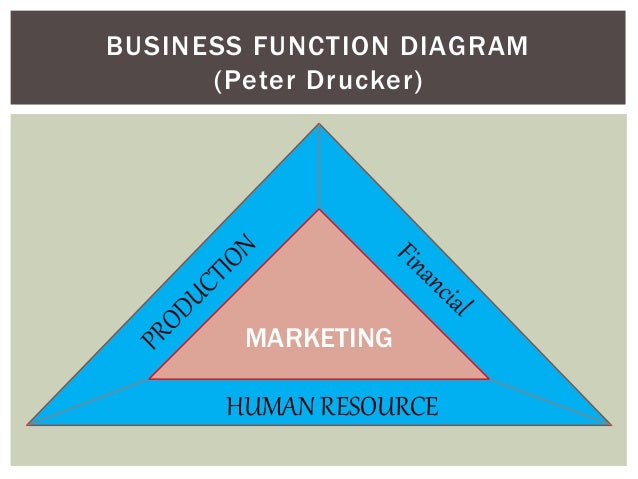
Business function diagram
(Peter Drucker)
Goal of the Marketing system
- Maximize Consumption
- Maximize Consumer Satisfaction
- Maximize Choice
- Maximize Life Quality
- Maximize Relationships
Trends Marketers will face in the 21st century
- Globalization
- Digital Age or information Age
- Call for more Ethics and Social Responsibility
- Growth of not for Profit Marketing
Strategic Planning
– it is the process of developing and maintaining strategic fit between the organizations goal and capabilities and it’s changing marketing opportunities.
steps in Strategic Planning:
- Define the company’s Mission and Vision
- Set company’s objective or Goals
- Design the business portfolio
- Planning Marketing and other functional strategies.
Terminologies:
- Vision – explains the company’s future and what it intends to be and how it can benefit to society.
- Mission – It is a statement of the organization’s purpose and what to accomplish in the larger environment.
- Objective – defines what you want to accomplished depending on its business activities. Guide in writing an objective is SMARTC: Specific, measurable, relevant, time bound, and challenging.
- Business Portfolio – it is the collection of businesses and products that make up the company.
- Portfolio Analysis – the process by which the management evaluates the products and business that make up the company.
- Strategic business unit (SBU) – it is the unit of the company that has a separate mission and objectives and that can be planned independently from other company businesses.
Types of portfolio planning methods
- Boston Consulting Group Approach – company classifies all it’s SBU’s according to the growth-share matrix.
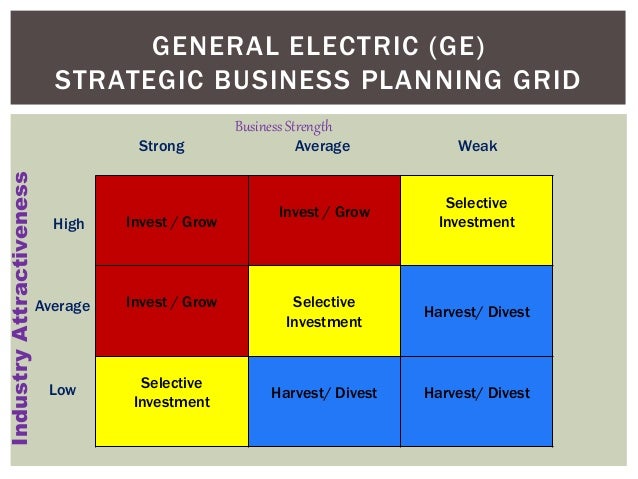
- GE Strategic Business planning Grid/ Approach – it is also called as the strategic business-planning grid. It uses business strength and industry attractiveness.
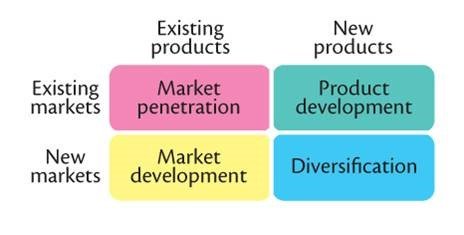
- Product/ Market Expansion Grid ( Ansoff Matrix) – It involves finding businesses and products the company should consider in the future.
Boston consulting group (BCG)

STAR – High Market Share and High Market Growth. Doing well, great opportunities.
CASH COW – High Market Share and Low Market Growth. Doing well in no growth market with limited opportunities.
QUESTION MARK – Low Market Share And High Market Growth. Don’t know what to do with opportunities Decided whether to increase investment
DOGS - Low Market Share and Low Market Growth. Weak on market, difficult to make profit.
General Electric (GE)
Strategic Business Planning Grid
Product/ Market Expansion Grid
( Ansoff Model)
Three levels of marketing
- Strategic Marketing Management
- Marketing Strategy
- Marketing Tactics
Marketing Process Model
(Kotler)
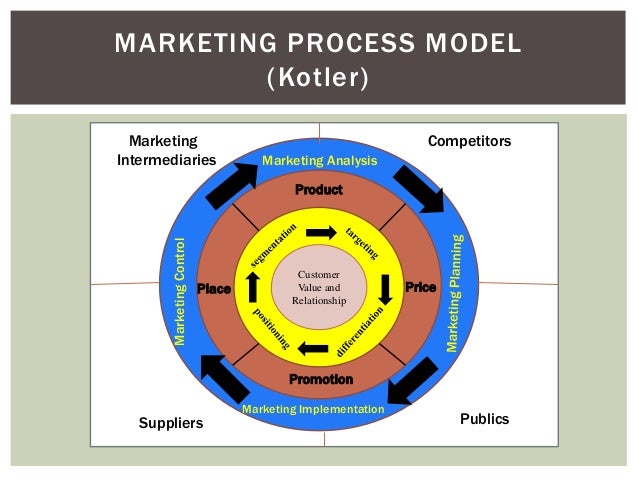
- Marketing Strategy – the marketing logic by which the business unit hopes to create customer value and achieve profitable customer relationship.
- Customer Value – it is the total worth of the customer to the firm.
- Customer Relationship Management – it is the overall process of building and maintaining profitable customer relationships by delivering superior customer value and satisfaction.
- Market Segmentation – dividing the market into distinct groups of buyers who have different needs, characteristics, or behavior and who management require separate products on marketing program.
- Market Targeting – the process of evaluating each segment’s attractiveness and selecting one or more segments to enter.
The 4c’s related to 4p’s of marketing
- Product = Customer Solution
- Price = Customer Cost
- Place = Convenience
- Promotion = Communication
Additional P’s in the Marketing
- People – it is maintaining and developing the employees of the company in order to offer superior service quality to its customers.
- Physical Environment – these are all visible cues that provide tangible evidence of the firm’s service quality.
- Process – it is the method and sequence of actions in the service performance.
- Profitability – the amount of sales or income generated from the operations of the business.
Marketing management
– it is the process of conceptualizing, analyzing, planning, implementing, and controlling marketing activities to achieve the organization’s desired result areas.
Four functions of marketing management
- Marketing Planning – involves in deciding on marketing strategies that will help the company attain its overall strategic objectives.
- Marketing Analysis – Understanding the strengths, weaknesses, opportunities and threats a company it will encounter in the market.
- Marketing Implementation - the process that turns marketing strategies and plans into marketing actions in order to accomplish strategic marketing objectives.
- Marketing Control – this is the management of marketing activities and ensuring marketing objectives are met.
– it is the actions and forces outside marketing that affect marketing management ability to build and maintain successful relationships with customers.
Two Types of Environment:
- Microenvironment
- Macroenvironment
Microenvironment
– this is the actors or parties close to the company that affect it’s ability to serve the customers. The company has a degree of control to this parties.
Types of Microenvironment
- Publics – these are the groups that has an actual or potential interest that has an impact on an organization's ability to achieve it’s objectives.
- Marketing Intermediaries – firms that help the company to promote, sell, and distribute it’s goods to the final buyers.
- Supplier – these are businesses that provide the necessary materials, services, labor, or combination to a firm.
- Customer – the reasons why the competition exist.
- Competitors – these are the companies that offer the same products and services vs. another firm.
Types of Competitors
- Direct Competitor– competitors that are closely related to the offered products/ services by the company.
- Indirect Competitors – competitors that are distant to the offered products/ services by the company.
- Monopolistic Competition – The price of the product is determined by the market and not by the buyer or seller.
- Pure Competition – there are many sellers that compete with each other.
- Oligopoly – There are only few firms that compete in a given industry. Prices are set in collusion with one another.
- Monopoly – it exist when there is only one single seller in a particular market and there is no close substitute for it.
Microenvironment
– these are the larger societal forces that affect the microenvironment.
Types of Microenvironment:
- Demographic Environment – includes human population in terms of age, size, density, location, religion, gender, etc.
- Factors involve in Demographics Environment:
- Changing age structure and population
- Changing Filipino Family
- Geographic shifts in population
- Better Educated society
- Interest in Minority groups/ regional groups
- Economic Environment – factors that affect consumer buying power and purchasing patterns.
- Factors involved in Economic Environment:
- Changes in Income
- Changing Consumer Spending Patterns
- Engels Law – pertains on how people shifts their spending across food, housing, transportation, healthcare and other goods/ services.
- Natural Environment – Natural resources that are needed as inputs by marketers or that are affected by marketing activities.
- Factors involved in Natural Environment:
- Environmental Sustainability
- Global Warming
- Efficient use of resources
- Technological Environment – forces that create new technologies, creating new products and marketing opportunities.
- Factors involved in Technological Environment:
- Increase research and development
- Speed of technological Innovation
- Strict quality Standards
- Growth of E-commerce, the internet and social networking sites.
- Political Environment – laws, government agencies and pressure groups that influences limits various organizations and individuals in a given society.
- Factors involved in Political Environment:
- Legislation Regulating business
- Increase emphasis on business ethics
- Cultural Environment – Institutions and other forces that affects society’s basic values perceptions, preferences and behavior.
- Factors involved in Cultural Environment:
- Persistent of cultural Values
- Shifts in Secondary Values
- Peoples views or opinion
Marketing Mix: The service Product
Service Product – It typically consists of a core product bundled with a variety of supplementary products.
KEY STEPS IN PLANNING AND CREATING SERVICES
- Statement of Objectives
- Market and Competitive Analysis and Resource allocation Analysis
- Marketing Assets Statement – includes the details of the firm's existing customer portfolio, marketing Knowledge, product line, etc.
- Service Marketing Concept – it clarifies the benefits offered to customers and the cost they will incur in return
- Service Operations Concept – It stipulates the nature of the processes involved and how and when the various types of operating assets should be deployed
- Service Delivery Process
Defining the Nature of the service offering
- Core Service – it responds to the customers need for a basic benefit.
- Supplementary Services – Facilitate and enhance the use, value and appeal of core services.
- Delivery Process – it deals with the procedures used to deliver both the core product and each of the supplementary services
- Documenting the Delivery Services over Time
Flower of services

Identifying and Classifying supplementary services
- Facilitating Services
- Information
- Order Taking
- Billing
- Payment
- Enhancing Services
- Consultation
- Hospitality
- Safekeeping
- Exception
Product Line
It is the group of products that are closely related because they function in a similar manner, are sold to the same customer groups, are marketers to the same types of outlets or fall within given price ranges.
Brand
It is a name, term, sign, symbol, or design or a combination of these intended to identity the goods or services of one seller or group of sellers from those of competitors.
Categories of new services
- Major Services Innovations – are new core products for markets that have not been previously defined.
- Major Process Innovations – consists of using new processes to deliver existing core products in new ways with additional benefits.
- Product line Extensions – Additions by existing products as to offer more convenience or a different experience to customers.
- Process line extensions – delivers new ways to existing products as to offer more convenience or a different experience to customers.
- Supplementary services innovations – take the form of adding new facilitation or enhancing service elements to the core services
- Service Improvements – involve modest change of performance of current products
- Style Changes – it is the simplest type of innovation that is highly visible, create excitement and motivate employees.
Using research to design new services
- Market Synergy – services fits well with the image of the firm
- Organization Factors – strong inter-functional cooperation and coordination
- Market Research Factors – it must have a clear idea of the type of information to be obtained
Pricing approaches in services
Price – amount of money charged for a product or service sum of the values that consumers exchange for the benefits of having or using the product or service.
The many names of price:
- SCHOOL - TUITION FEE
- TRANSPORTATION - FARE
- APARTMENT - RENT
- BANK - INTEREST/BONDS/RATES/CHANGES
- INSURANCE - PREMIUMS/ INTEREST/DIVIDENDS
- RESTAURANT - BILL/CHIT/TIP/COST
- MOVIE HOUSE OR THEATER - TICKET
- GOVERNMENT ASSISTANCE - SUBSIDY/ ALLOWANCES
- CONSULTANCY FIRM - HONORARIUM

No comments:
Post a Comment